Change

AT&T Fiber vs. AT&T Internet Air

Confused about the difference between AT&T Fiber and AT&T Internet Air? We’re here to help.

At AT&T Experts, we analyze AT&T services to help households understand how different plans perform in real-world situations.

Pricing and value

Breaking down the 2026 costs

When it comes to pricing, AT&T Fiber and AT&T Internet Air take different approaches. Fiber plan prices vary by speed tier and market, while Internet Air offers a single straightforward plan with consistent pricing. 

Both offer bundle discounts with wireless service—often up to 20% off when you add an eligible Unlimited AT&T Wireless plan.

AT&T Fiber pricing

AT&T Fiber includes a range of speed tiers—from 300 Mbps to 5 Gigs—and prices vary by your exact location and the plan you select.

What this means: Fiber pricing typically starts low with promotional offers but can increase after the introductory period. With an AT&T Fiber plan, you get unlimited data and a choice of multiple speed levels, which makes it a scalable option for households with many users or high-bandwidth needs.

AT&T Internet Air pricing

AT&T Internet Air is a single-plan 5G home internet offering with simple pricing: around $60/mo. plus taxes for the baseline service. 

What this means: Internet Air’s straightforward pricing—no contracts, no annual price increases, and no overage fees—makes it an easy way to get online, especially for people who don’t want to decide between multiple speed tiers or promotional terms.

Plan / Tier
Connection Type
Typical Monthly Price
Typical Upload/Download Speeds
AT&T Internet Air
5G Fixed Wireless
~$60/mo
Up to 300 Mbps download/8-30 Mbps upload
Fiber 300
Fiber
~$35/mo
300/300 Mbps
Fiber 500
Fiber
~$45/mo
500/500 Mbps
Fiber 1 Gig
Fiber
~$60/mo
1,000/1,000 Mbps
Fiber 2 Gig
Fiber
~$125/mo
2,000/2,000 Mbps
Fiber 5 Gig
Fiber
~$245/mo
5,000/5,000 Mbps

AT&T may temporarily slow data speeds if the network is busy.

Speeds based on wired connection. Actual speeds may vary. For 5GIG, single device wired speed maximum 4.7Gbps. For more info, go to www.att.com/speed101.

Price: Plus taxes. after current discounts, autopay & paperless bill discount (w/in 2 bills). Monthly State Cost Recovery charge applies in NV, OH, TX. One time install fee may apply. Limited availability in select areas.

Understanding the two technologies

Before digging deeper into performance and features, it helps to understand what these two products actually are:

An excited man and woman sitting on a gray sofa holding controllers while playing video games together in a decorated living room.
What is AT&T Fiber?

It’s traditional fiber-to-the-home broadband. AT&T Fiber uses thin glass strands to deliver internet signals directly to your house or apartment, offering fast, reliable, and very high-capacity connectivity. Fiber is one of the most stable and consistent internet service options available today.

A smiling young woman sitting at a desk with a laptop and open book while using her smartphone, with a white internet router visible in the background.
What is AT&T Internet Air?

It’s a fixed wireless home internet service delivered over AT&T’s 5G network. Instead of a wired connection running into your home, Internet Air uses a wireless gateway (the AT&T All-Fi™ Hub) that connects to AT&T’s 5G cellular network—similar technology to that used by many mobile phones.

Speed and performance comparison

What do you actually need?

Speed is one of the biggest factors people consider when choosing an internet plan, but the numbers alone don’t tell the whole story. Instead of raw Mbps figures, think about how the connection performs during everyday use:

AT&T Fiber speeds

Fiber plans scale from lower tiers up to multi-gigabit connections where available. Because fiber delivers internet over a physical connection, it can offer symmetrical upload and download speeds—that means uploading big files, backing up to the cloud, or hosting video calls feels just as fast as downloading movies or loading web pages.

In practical terms, if your household streams 4K video on multiple devices, plays online games, works from home with frequent video conferencing, or uploads large creative files, fiber’s stable, high-bandwidth connection is often the better fit.

Installation and setup

Pro-install vs. plug-and-play

A smiling technician in a blue uniform shows an internet gateway to a man and a young girl in their home.

Fiber installation

AT&T Fiber requires a professional installation. A technician comes to your home, runs fiber cabling to your house or unit, and installs the necessary gateway equipment.

Practical reality: Depending on where you live, scheduling can take time—and if you’re in a large apartment building or a location without fiber infrastructure, there may be additional hurdles. But once installed, you get a fully wired connection that’s typically more consistent and scalable.

This setup is ideal for permanent homes or long-term residences where maximizing internet performance and reliability matter most.

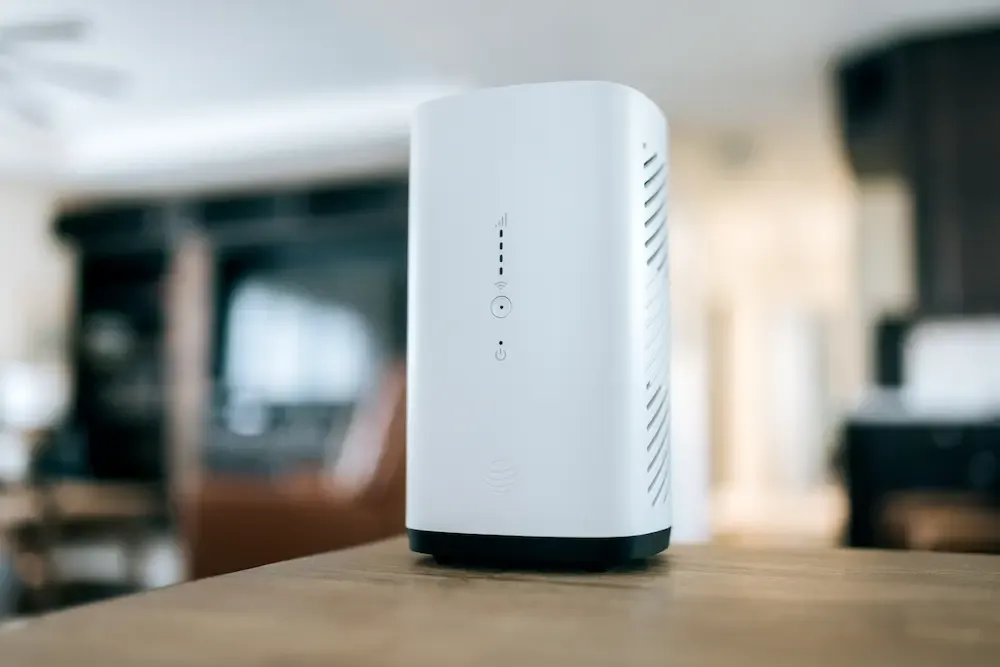
A close-up shot of a white AT&T Internet Air gateway standing on a wooden surface with a blurred living room in the background.

Internet Air installation

Internet Air is self-install by design. You receive the AT&T All-Fi™ Hub, plug it in, and connect your devices. There’s no drilling, no technician visit, and no need to wait for scheduled appointments.

Practical reality: This makes Internet Air especially appealing to renters, short-term leaseholders, or households seeking an uncomplicated setup without professional installation.

Which AT&T Internet plan is right for you?

Here’s a quick decision module to help you match your internet use case with the right service, without defaulting to vague claims about which is “best.”

AT&T Fiber fits you if:
  • You work from home and host frequent video meetings.
  • You upload large files regularly (e.g., video content, backups).
  • Your household streams high-definition or multi-device content daily.
  • You want a connection that’s typically more stable and less affected by network congestion.
  • You plan to be in your residence long-term.
AT&T Internet Air fits you if:
  • You’re in temporary housing or renting.
  • You want a quick, plug-in self-install internet connection without a technician.
  • You use the internet mainly for social media, browsing, and standard video streaming.
  • Your home is in an area with strong 5G coverage.
  • You want simple pricing with no annual contract.

Frequently asked questions

Is AT&T Internet the same as DSL?

No, AT&T Internet is not the same as DSL. DSL was AT&T’s older copper-based service, phased out in favor of fiber and wireless options. Neither AT&T Fiber nor Internet Air uses DSL technology.

Why is Fiber better than 5G Home Internet?

Fiber isn’t universally “better,” but it does offer more consistent speeds and higher capacity, thanks to its physical fiber-optic connection. Wireless home internet, such as Internet Air, can be more variable depending on signal and network conditions.

Does AT&T Fiber have a data cap?

No. AT&T Fiber plans include unlimited data, so you don’t have to worry about hitting a usage limit. With an AT&T Fiber Internet connection, you can stream, work, and game online without worrying about data caps or overage fees.

Can I switch from Internet Air to Fiber later?

Yes, you can switch from AT&T Internet Air to Fiber. If AT&T Fiber becomes available at your address after you’ve signed up for Internet Air, you can typically transition to fiber service through AT&T’s ordering process.

Do I get a discount for bundling with my cell phone?

Yes! AT&T offers roughly 20% off home internet service when you bundle an eligible Unlimited Wireless plan with either AT&T Fiber or Internet Air, typically within your first couple of billing cycles. Check out our AT&T Services hub to learn more about bundles and other services AT&T provides.

AT&T Fiber and AT&T Internet Air serve different types of households. Fiber offers the highest performance and reliability for demanding internet users, while Internet Air provides a flexible, simple setup for households that want straightforward connectivity without installation complexity.